
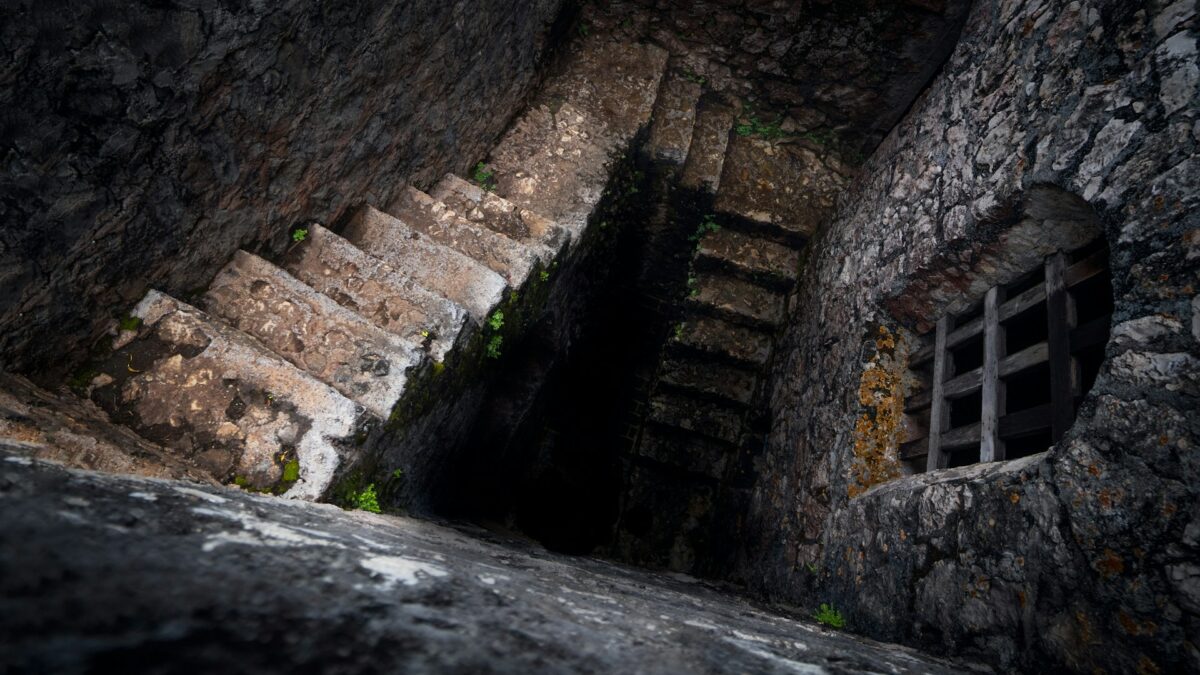
Creating interesting dungeons can pose a handful of questions, and can be difficult for a first time game master to design themselves. Below I outline a handful of the ways that I approach dungeon design to keep my players engaged and to create a fun session. If you like what you see here, sign up for my newsletter to get helpful tips and trick in your inbox. If you use the form below, you can download my FREE 5e Adventure, The Pirate Queen’s Wrath.
What’s Going On?
That’s the big question, isn’t it? What’s happening? To start out, I’ll usually write out a short sentance or two of what’s been happening. Maybe there’s been ghosts spotted on the trails, an increase in bandit attacks, or other strange occurrences have been happening nearby. It sets a small piece of the tone that we can expand on later.
Once I’ve got that out of the way, it’s time to write up some history on the location. Was it a fortress run by a cult of necromancers? Was this a former site of a great battle and there’s magical artifacts hidden deep below? This gives us something to sink our teeth into and that we can use to fill out the inhabitants, the big bad, and any traps or obstacles in their way. It’s best to leave a few good clues with a short summary. These should be things the game master can build off of later and easy to reference.
Why Do The Players Care?
The other important question to ask. Why do the players care? Normally referred to as adventure hooks, it gives the players a reason to go diving into the dungeon. If there’s no reason, then why would they even step inside? In my experience, it’s a good idea to group these into a couple of different sections with a few different options each. Remember, not everyone is out to do the right thing. Is there a lust for power or gold the players could be after? Do they have a stake in the region itself? Try to get creative. Providing a handful can give multiple players different reasons to go inside.
Building The Dungeon
Personally, this is my favorite part of the whole operation. To start, I like to decide on the number of rooms my dungeon will have. I’ve found between 6-10 to be the perfect amount for a single session. Since players won’t go through every room, it ensures there’s enough encounters to make it a memorable adventure. I typically begin by creating the entrance to the dungeon and branching my rooms off from there. I make it a rule to myself that I will always have a minimum of two paths out of a room. In my experience, this allows players to feel they have greater control, even though every encounter has been planned for in advance. It might not work for everyone, but I like to make an interesting layout first before I design my encounters.
Dungeon Inhabitants
Now that we’ve got our rooms laid out, we get to decide who’s been living here before we arrived. I try to always decide on at least two or three groups. I normally will decide on the “bad guys” first, so to speak. If there’s an undead lich or bandits, or maybe even cultists. I try to ties these in to the history of the location and what’s been happening. Since they’re usually the main big bad, I’ll design the final encounter around them, with maybe some weak enemies to be encountered early on to give a taste for what’s to come. After that, I’ll add in some other inhabitants who might not be related at all. I’ve had fun creating townsfolk who tried to investigate on their own but got overpowered, or even lazy knights who’ll pay the players to go in and do their job for them. These are the inhabitants who might not directly be in combat, but who’ll still get involved in the mayhem.
Traps & Tricks
Besides the combat encounters, I’ll try to throw in some traps or strange occurrences the player’s will have to deal with as well. A big part of my philosophy is that every trap should be telegraphed to the players to an extent. Anything that feels like a “gotcha” or that removes player agency is something I try to stay away from. At best it’ll make the players feel like their actions don’t have consequences, and at worst they’ll feel like the game master is telling them a story instead of playing in one. The best advice I’ve ever seen about creating traps is that you should only create the problem, and let the players design the solution. Building them this way makes the players feel like they’re overcoming the odds and gives them their own agency to build the narrative along with you. In short, if it feels frustrating to play it, don’t include it!
The Big Bad
My favorite encounter to build is the big bad. This is for all the marbles, the one they’ve came to defeat. There’s a couple of things I try to keep in mind to make the final fight feel worthy. My biggest rule is don’t let it become a slugfest. A common mistake I’ve seen many times, is for the big fight to be one enemy with really high HP that acts as a big damage sponge. Quite frankly, these fights are boring! It doesn’t ask any interesting questions. You attack, role, maybe deal damage? Then wait for everyone to do the same thing for the next hour or so until everyone’s dead or your victorious. Sounds boring, right? That’s why I try to give them lower health and populate the fight with some stronger minions. That way it forces the players to make a decision; Do I attack the big bad, or take out his minions? On top of that, try to build a trap in as well. Maybe they can only take damage once their minions are slain, or they feed off the damage the players take to grow strong. Try to make it so the players have to make decisions that have a level of impact included. I really try to treat the final encounter as another puzzle that needs to be “won” to succeed.
The Payoff
Once they’ve made it through the dungeon and have slain the big bad, it’s time for the pay off. While the loot is always important (let’s face it, it’s why we’re all here really), so is the narrative it sets up. How did the outcome affect the world? Does it set up a second part, or any ramifications? The best dungeons aren’t just a loot fest with some combat thrown in, but how it builds into the overall narrative of the game. The outcome of every adventure should continue to affect and change the overall narrative. Try to think up a handful of hooks as well on where they could go next or if there’s something they should investigate.
Conclusion
These are the ways that I approach dungeon and encounter design. If you like what you see here, sign up for my newsletter to get helpful tips and trick in your inbox. If you use the form below, you can download my FREE 5e Adventure, The Pirate Queen’s Wrath. Thanks for reading!